
Men's Hair Loss Is More Common Than Most Men Think
Hair loss affects millions of men worldwide and is one of the most common cosmetic concerns among adult males. While many people associate male hair loss with complete baldness, most men actually experience gradual thinning over many years. In the early stages, the changes can be subtle—slightly less volume, increased scalp visibility under bright lighting, a thinning crown, or a receding hairline.
For many men, these changes happen slowly enough that they are easy to ignore at first. Eventually, however, photographs, mirrors, or comments from friends and family may reveal that the hair appears thinner than before.
Hair plays an important role in self-confidence and appearance. Although hair loss is a normal part of aging for many men, it can still affect confidence, self-esteem, and the way someone feels in professional and social situations.
Fortunately, today’s men have more options than ever before. Medical treatments, hair transplants, scalp micropigmentation (SMP), and newer cosmetic procedures like MoriTint™ Hair Density Enhancement each serve different purposes.
Understanding which option is best depends largely on the type and severity of hair loss.
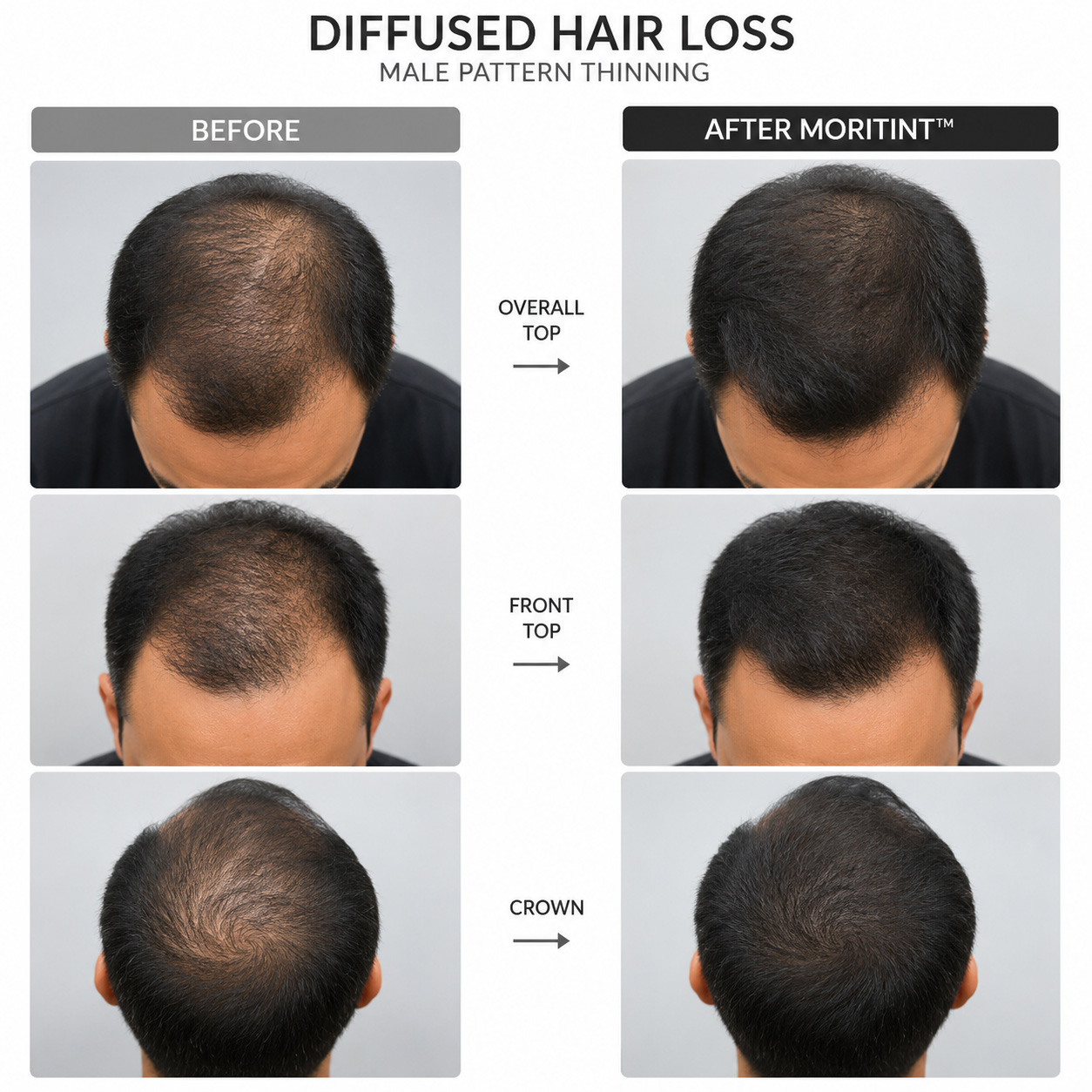
Understanding Men’s Hair Loss
Male hair loss usually develops gradually. Most men begin noticing changes during their twenties or thirties, although some experience thinning much earlier while others maintain a full head of hair well into later life.
Hair loss often follows predictable patterns:
- Receding hairline
- Thinning temples
- Crown thinning
- Diffuse thinning
- Reduced overall density
- Increased scalp visibility
Not every man loses hair in the same way. Some retain a strong hairline while the crown gradually thins. Others experience diffuse thinning across the entire top of the scalp while still maintaining their original hairline.
Understanding your pattern of hair loss is one of the first steps toward choosing the most appropriate treatment.
What Causes Men’s Hair Loss?
Several factors can contribute to hair loss in men.
Genetics
The most common cause is male pattern hair loss (androgenetic alopecia), an inherited condition that causes hair follicles to gradually shrink over time. As the follicles become smaller, the hair grows finer until it may eventually stop growing altogether.
Hormones
The hormone DHT (dihydrotestosterone) plays a major role in male pattern hair loss. Men who are genetically sensitive to DHT often experience gradual miniaturization of hair follicles.
Aging
Hair naturally becomes finer with age. Even men who do not experience significant baldness often notice reduced hair density as they get older.
Stress
Physical illness, surgery, emotional stress, or major life events can trigger temporary shedding known as telogen effluvium.
Medical Conditions
Certain medications, thyroid disorders, autoimmune diseases, nutritional deficiencies, and other health conditions can also contribute to hair loss.
Because treatment depends on the underlying cause, men experiencing sudden or significant hair loss should consult a qualified healthcare professional for an evaluation.
The Emotional Impact of Men’s Hair Loss
Hair loss is often viewed as a normal part of aging, but that doesn’t mean it has no emotional impact.
Many men report:
- Feeling older than they actually are
- Becoming more self-conscious in photographs
- Avoiding overhead lighting
- Constantly checking mirrors
- Wearing hats more frequently
- Styling their hair differently to hide thinning
- Feeling less confident in business or social settings
Some men simply shave their heads and embrace the change. Others prefer to maintain their existing hairstyle and explore ways to improve the appearance of density.
There is no right or wrong choice. The best option depends on personal preference, lifestyle, and the pattern of hair loss.
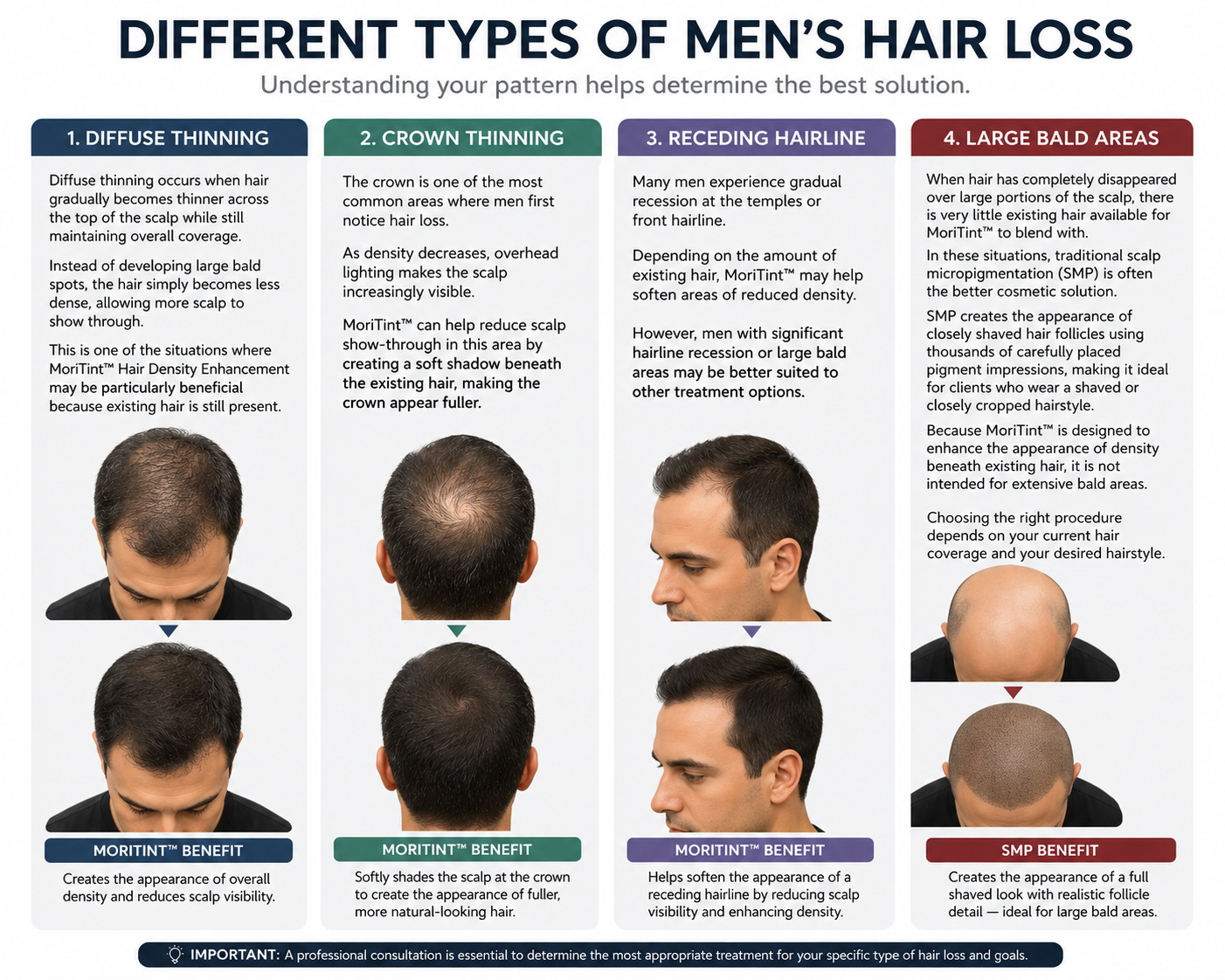
Different Types of Men’s Hair Loss
Diffuse Thinning
Diffuse thinning occurs when hair gradually becomes thinner across the top of the scalp while still maintaining overall coverage.
Instead of developing large bald spots, the hair simply becomes less dense, allowing more scalp to show through.
This is one of the situations where MoriTint™ Hair Density Enhancement may be particularly beneficial because existing hair is still present.
Crown Thinning
The crown is one of the most common areas where men first notice hair loss.
As density decreases, overhead lighting makes the scalp increasingly visible.
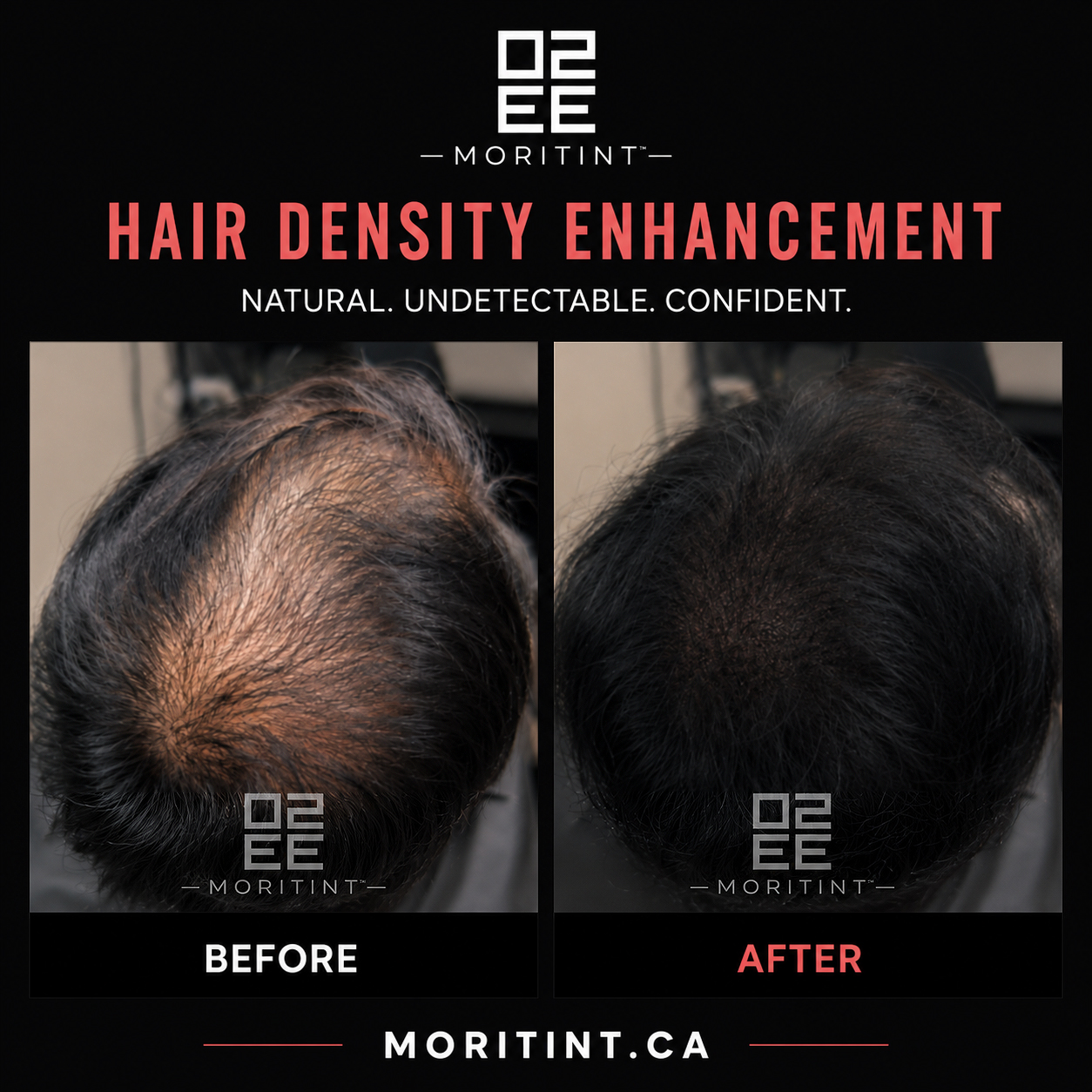
MoriTint™ can help reduce scalp show-through in this area by creating a soft shadow beneath the existing hair, making the crown appear fuller.
Receding Hairline
Many men experience gradual recession at the temples or front hairline.
Depending on the amount of existing hair, MoriTint™ may help soften areas of reduced density. However, men with significant hairline recession or large bald areas may be better suited to other treatment options.
Large Bald Areas
When hair has completely disappeared over large portions of the scalp, there is very little existing hair available for MoriTint™ to blend with.
In these situations, traditional scalp micropigmentation (SMP) is often the better cosmetic solution.
SMP creates the appearance of closely shaved hair follicles using thousands of carefully placed pigment impressions, making it ideal for clients who wear a shaved or closely cropped hairstyle.
Because MoriTint™ is designed to enhance the appearance of density beneath existing hair, it is not intended for extensive bald areas.
Choosing the right procedure depends on your current hair coverage and your desired hairstyle.
What Is MoriTint™ Hair Density Enhancement?
MoriTint™ is a Korean-inspired cosmetic procedure that creates the appearance of fuller-looking hair using advanced scalp tinting techniques.
Instead of creating the look of individual shaved hair follicles, MoriTint™ softly shades the scalp beneath existing hair.
By reducing the contrast between light scalp and darker hair, thinning areas become less noticeable and the hair appears denser.
The treatment is designed for men who still have existing hair but want to improve the appearance of density.
How MoriTint™ Helps Men with Diffuse Hair Loss
Diffuse thinning is one of the best indications for MoriTint™.
Because hair remains throughout the treatment area, the pigment blends naturally beneath the existing hair.
Benefits include:
- Reduced scalp visibility
- Fuller-looking hair
- Improved crown density
- Softer appearance than traditional SMP
- Natural-looking results
- No surgery
- Minimal downtime
- Can complement other hair restoration treatments
The goal is not to create new hair.
The goal is to create the appearance of greater density.
MoriTint™ vs Traditional Scalp Micropigmentation
Although both procedures involve pigment placement, they are designed for different clients.
MoriTint™
Best for:
- Diffuse thinning
- Crown thinning
- Longer hairstyles
- Existing hair coverage
- Men wanting density enhancement
Creates:
- Soft scalp shading
- Fuller appearance
- Reduced scalp contrast
Traditional SMP
Best for:
- Large bald areas
- Advanced baldness
- Shaved hairstyles
- Hairline recreation
- Buzz-cut appearance
Creates:
- Individual follicle impressions
- Shaved-head illusion
- Hairline definition
Neither treatment is better than the other.
They simply solve different problems.
Can MoriTint™ Be Combined with Other Hair Loss Treatments?
Yes.
Many men combine MoriTint™ with:
- Hair transplants
- PRP therapy
- Prescription medications
- Topical treatments
- Low-level laser therapy
- Nutritional programs
Because MoriTint™ works cosmetically rather than medically, it often complements treatments intended to support hair growth.
Benefits of MoriTint™
Men often choose MoriTint™ because it offers several advantages.
Benefits may include:
- Creates the appearance of fuller hair
- Reduces visible scalp
- Natural-looking results
- Works with existing hair
- Non-surgical procedure
- No scarring
- Minimal downtime
- Can complement hair transplants
- Long-lasting cosmetic enhancement
- Helps reduce reliance on hair fibers and concealers
Is MoriTint™ Right for You?
You may be a good candidate if you:
- Have diffuse thinning
- Have crown thinning
- Still have good hair coverage
- Notice visible scalp through your hair
- Want fuller-looking density
- Prefer natural-looking results
- Want a non-surgical cosmetic solution
You may not be the ideal candidate if you:
- Have extensive bald areas
- Wear a completely shaved hairstyle
- Want to recreate an entirely new hairline without existing hair
In these situations, traditional scalp micropigmentation may provide a better cosmetic result.
A professional consultation can help determine which approach best matches your hair loss pattern and goals.
Frequently Asked Questions
Does MoriTint™ regrow hair?
No. MoriTint™ is a cosmetic hair density enhancement procedure that improves the appearance of density by reducing scalp visibility. It does not stimulate new hair growth.
Is MoriTint™ permanent?
No. Most clients require maintenance touch-ups every one to two years depending on skin type, lifestyle, sun exposure, and desired appearance.
Does MoriTint™ look natural?
When properly performed, MoriTint™ is designed to blend beneath existing hair to create a soft, natural-looking density effect.
Is MoriTint™ painful?
Most clients find the procedure very tolerable. Comfort levels vary depending on the treatment area and individual sensitivity.
Can MoriTint™ replace a hair transplant?
Not necessarily. Hair transplants and MoriTint™ serve different purposes. Some men choose one treatment, while others combine both to maximize the appearance of density.
Restore the Appearance of Fuller Hair
Hair loss doesn’t always mean complete baldness. Many men still have substantial hair coverage but struggle with diffuse thinning, visible scalp, or reduced crown density.
For these men, MoriTint™ Hair Density Enhancement offers a non-surgical cosmetic solution designed to reduce scalp visibility and create the appearance of thicker, fuller-looking hair.
If your hair has become thinner but you still have existing coverage, MoriTint™ may help restore confidence by enhancing the appearance of natural density.
If your hair loss has progressed to large bald areas or you prefer a shaved hairstyle, traditional scalp micropigmentation (SMP) may be a more appropriate option.
The best treatment always depends on your unique hair loss pattern, lifestyle, and goals.
Book a free consultation today
Find out whether MoriTint™ Hair Density Enhancement or another hair restoration option is the best choice for you.